
Buying property in Thailand without checking the title deed properly is one of the most expensive mistakes you can make. Fake chanotes exist. Encumbered land gets sold without disclosure. Boundaries on paper do not always match what is on the ground. In Hua Hin alone, several buyers have discovered – after signing – that the land they purchased had an unregistered mortgage, or that the boundaries on the deed overlapped a neighbour’s plot.
This guide shows you exactly how to check a chanote title deed in Thailand, step by step, before you commit a single baht to any property purchase.
What Is a Chanote Title Deed?
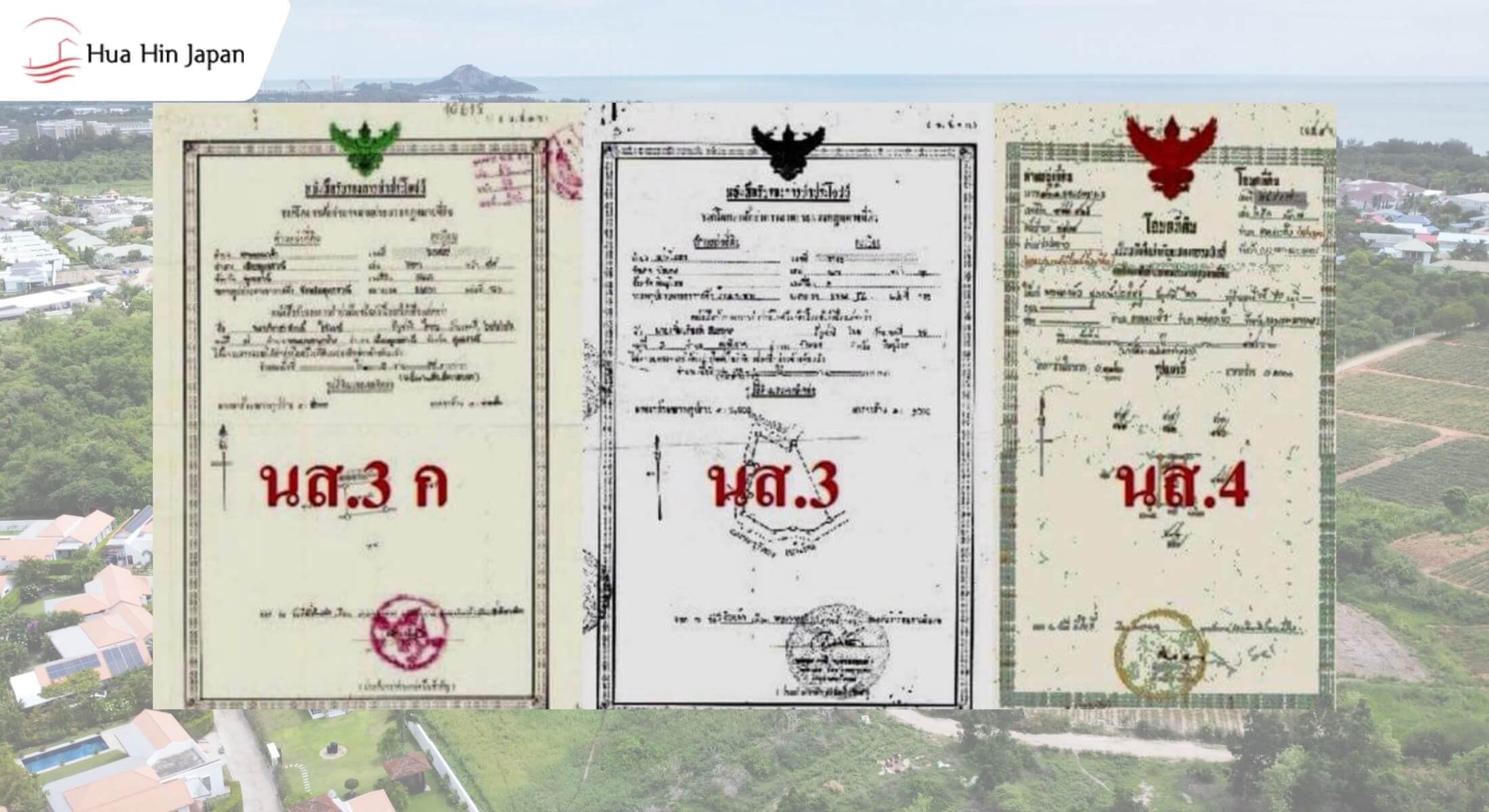
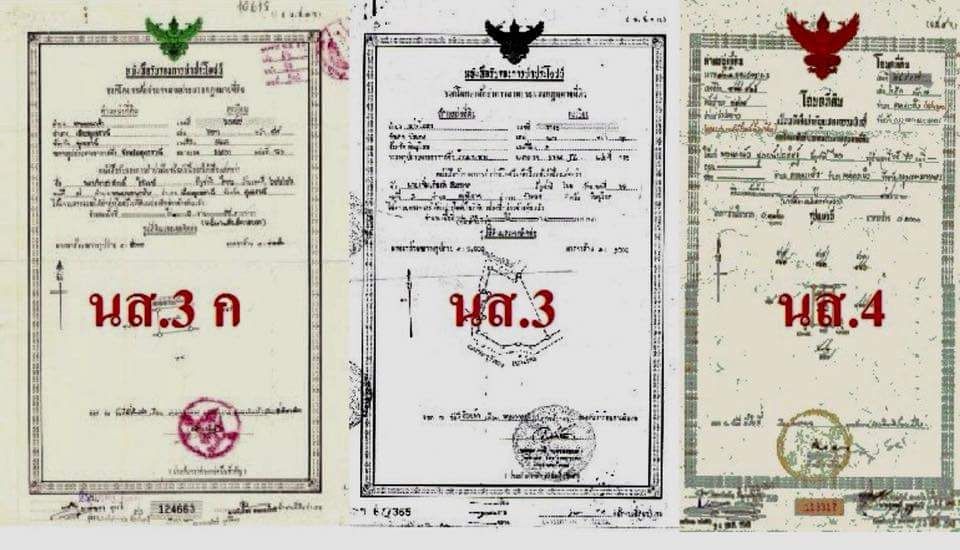
A Chanote (officially called Nor Sor 4 Jor) is Thailand’s highest level of land title. It is the only document that represents full, legal ownership of land. Chanote land has been precisely GPS-surveyed, registered on the national survey grid, and marked with permanent concrete or metal boundary posts on every corner.
If a property does not come with a Chanote – or a Nor Sor 3 Gor as a close second – you are taking on significantly more legal risk. Other title types like Nor Sor 3, Sor Kor 1, or Por Bor Tor 5 do not give you full ownership rights, and in some cases cannot even be sold or used as mortgage collateral.
KEY FACT
In Hua Hin and the surrounding Prachuap Khiri Khan area, the vast majority of properly developed residential and villa properties carry Chanote titles. This is one reason Hua Hin is considered a lower-risk market for foreign buyers compared to more rural parts of Thailand.
How to Check a Chanote Title Deed: 4 Steps
Step 1: Check the Physical Document Yourself
Ask to see the original title deed – never accept a photocopy as your only reference. A genuine Chanote has several features you can verify without any legal training.
What to look for on the original document:
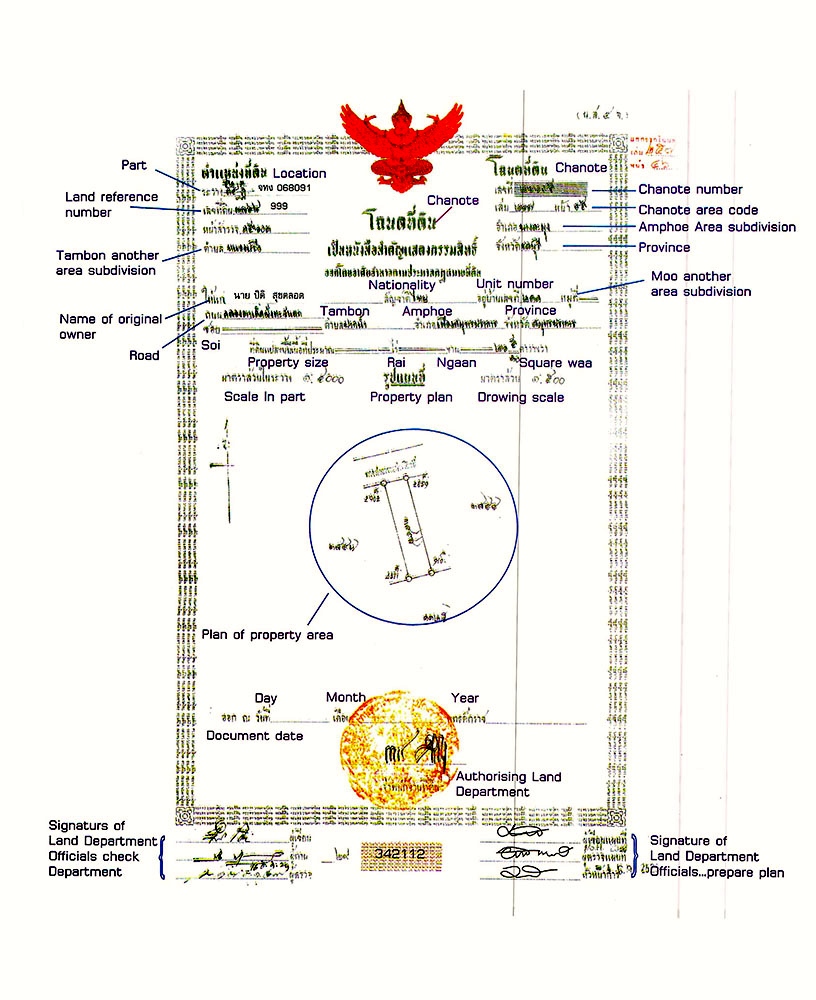
- Red Garuda symbol printed at the top – this is the official emblem of the Thai state
- The words ‘Nor Sor 4 Jor’ or ‘Chanote’ written clearly in the header section
- Hold the document to light – two Garuda watermarks should appear, plus the text ‘Department of Lands, Ministry of Interior’
- The corner circles on the document should show tiny backlit holes when held to the light
- The Land Department officer’s signature must be in black ink with a red official stamp overlapping it
- Check the paper quality – genuine Chanote paper is thick, government-issued stock, not standard printer paper
Step 2: Verify at the Land Office (Most Important Step)
Take the title deed number – or the original document – to the Provincial Land Office and request an official title search. This is called a ‘Land Section printout’ and it confirms whether the Chanote is genuine, who the registered owner is, and whether any encumbrances are registered against it. This step is non-negotiable.
What to bring to the Land Office:
- The original Chanote or its deed number
- Your passport (required for identification)
- Basic information about the property: location, plot number, rai/ngan/wah measurements
The Land Office will print an official record that shows the full ownership history, current registered owner, and all legal acts registered on the land. This costs almost nothing – typically 20 to 50 THB – and takes under one hour. If your lawyer or agent is discouraging you from doing this step, that is a serious red flag.
Step 3: Check the Back of the Deed for Encumbrances
The back of every Chanote lists every legal act ever registered against that land. This is where mortgages, usufructs, leases, and servitudes are recorded. An unregistered mortgage is legally unenforceable, but a registered one transfers with the land – meaning you could inherit someone else’s debt if you are not careful.
What to check on the back of the deed:
- Any active mortgage registered by a bank or private lender
- Registered leases (someone may already have a legal right to use the land for years)
- Usufructs or rights of habitation registered in another person’s name
- Servitudes – right-of-way or access rights granted to a neighbouring plot
- Confirm the current owner’s name matches who is selling to you
Step 4: Walk the Physical Boundaries and Confirm the Survey Markers
A Chanote is GPS-surveyed, but the markers on the ground must match the deed’s survey map. This step matters because markers can be moved by construction, floods, or bad actors. A licensed Thai surveyor charges around 15,000 to 25,000 THB and will confirm every corner post against the GPS coordinates in the deed. For any villa or land purchase above 5 million THB, this cost is negligible compared to the protection it provides.
- Locate the numbered concrete or metal posts at each boundary corner
- Match each marker number to the sketch map on the Chanote
- Do not rely on fences, hedges, or walls as boundary references
- If any marker is missing or disputed, request a Land Office resurvey before proceeding
Red Flags That Should Stop You Before You Sign
These are the warning signs that most property articles do not tell you about clearly enough. If you encounter any of the following, stop – and get a lawyer involved immediately.
| Red Flag | Why It Matters |
| Seller refuses to show the original Chanote | Only original documents should be used for due diligence. Photocopies can be altered. |
| Deed number does not appear in Land Office records | This is a fake document. Walk away and consider reporting to the police. |
| Garuda symbol is printed in blue (not red) | Blue Garuda indicates a Nor Sor 3 Gor, not a full Chanote. Different rights apply. |
| Active mortgage registered on the back of the deed | The mortgage must be discharged before transfer, or you could inherit the debt. |
| Physical land is smaller than what the deed states | Boundary markers may have been moved. Surveyor verification is essential. |
| Seller insists on urgency or no lawyer involvement | Legitimate sellers have no reason to rush due diligence. Pressure is a manipulation tactic. |
What Does Checking a Chanote Title Deed Cost?
| Verification Step | Approx. Cost | Essential? |
| Land Office title search and printout | 20 – 50 THB | Yes – always |
| Thai lawyer document review | 5,000 – 15,000 THB | Yes – strongly advised |
| Licensed surveyor boundary check | 15,000 – 25,000 THB | Yes for any land purchase |
| Full legal due diligence package | 25,000 – 60,000 THB | Recommended above 5M THB |
HUA HIN SPECIFIC NOTE
The Hua Hin Land Office (Prachuap Khiri Khan Provincial Land Office) is well-staffed and experienced with foreign buyer enquiries. Staff can usually assist with basic title searches with some English communication. For full due diligence, use a Hua Hin-based Thai property lawyer who has an established working relationship with the local Land Office – this speeds up verification significantly and reduces the chance of any process errors.
Questions People Ask About Chanote Title Deeds in Thailand
Can I check a Thai title deed online?
Thailand does not currently have a fully public online portal for title deed verification. The official Land Department website (dol.go.th) has some basic tools, but a formal verification must still be done in person at the Provincial Land Office. Some law firms offer remote title search services where they attend the Land Office on your behalf – useful for buyers who are not yet in Thailand.
What is the difference between a Chanote and a Nor Sor 3 Gor?
Both are issued by the Thai Land Department and are considered secure title documents. A Chanote (Nor Sor 4 Jor) carries a red Garuda and has been fully GPS-surveyed with permanent boundary markers. A Nor Sor 3 Gor carries a blue Garuda and has been surveyed, but with slightly less precision. Chanote is the gold standard. Nor Sor 3 Gor is a solid second option. Both allow registration of sales, leases, mortgages, and usufructs. Anything below these two carries meaningfully higher risk.
Is it possible to get a fake Chanote in Thailand?
Yes, fake Chanotes exist and have been used to defraud buyers. The Thai Supreme Court has convicted individuals for producing fraudulent title documents. This is exactly why physically verifying the deed at the Land Office is non-negotiable. A fake document will not appear in the Land Office records, which is how you catch it. Never transfer any payment before completing this step.
How long does a title deed check take at the Land Office?
A basic title search at the Provincial Land Office typically takes under one hour if you attend in person with the deed number. A full due diligence check including encumbrance history, boundary verification, and zoning confirmation usually takes two to five business days when handled by a local lawyer. Allow more time if the property is large, has complex history, or is in a newly developed area with pending documentation.
Final Word: Never Skip This Step
Checking a chanote title deed in Thailand is not complicated. It is not expensive. And it is the single most important thing you can do before buying property here. The Land Office title search costs less than your lunch. The lawyer review costs less than one month’s villa rent. The surveyor check costs less than 0.5% of your purchase price.
What you are buying when you get this right is certainty. You know the land is real, the owner is genuine, and there are no hidden claims sitting on the back of that document waiting to become your problem. That certainty is worth far more than the small cost and time it takes to secure it.
In Hua Hin, the property market is mature and the Land Office is well-functioning. Chanote verification here is more straightforward than in many other parts of Thailand. But that does not mean you skip the process – it means you are in a good position to get it done efficiently and move forward with confidence.



 English
  Japanese
Join The Discussion