
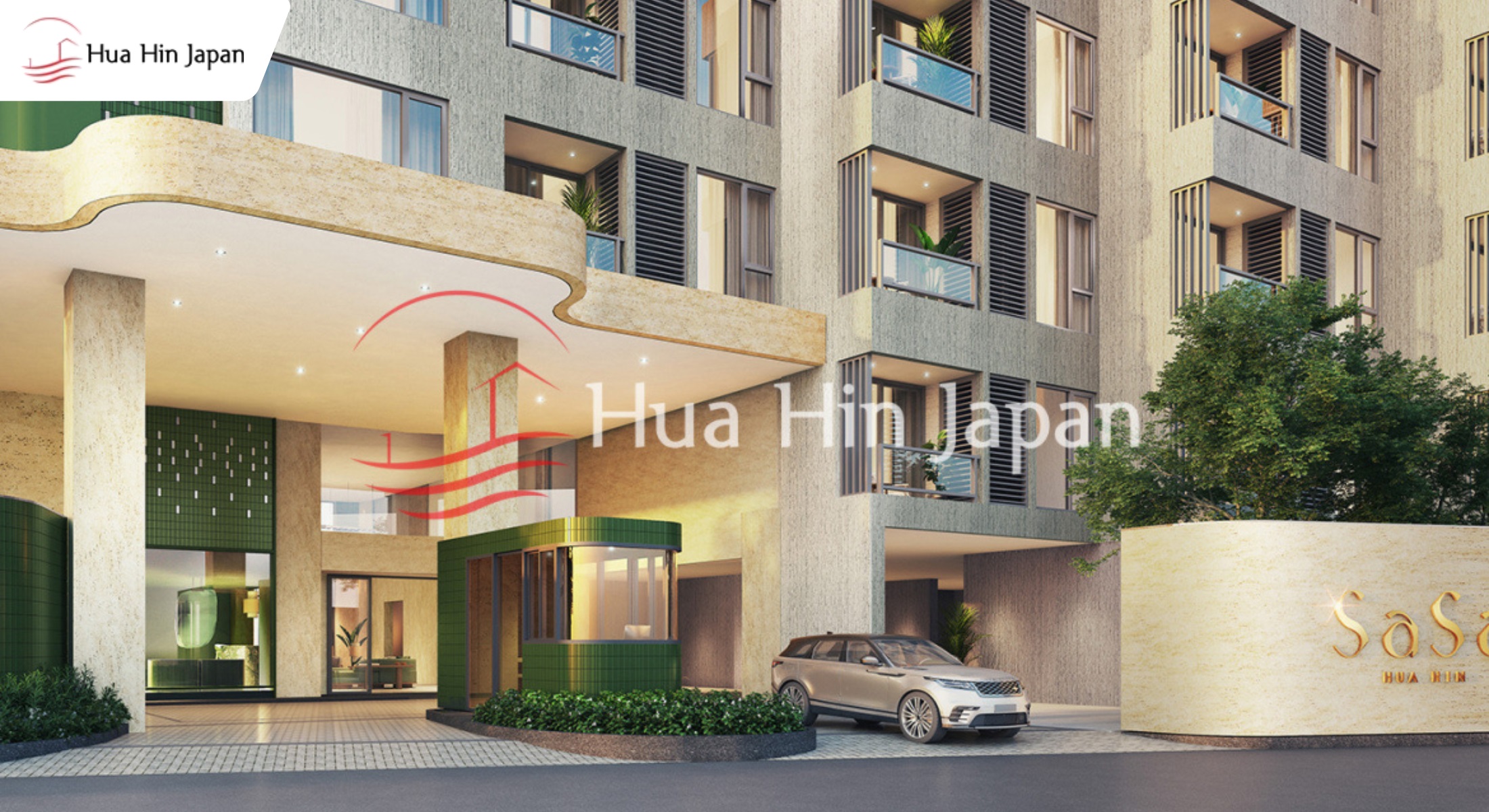
Hua Hin has become one of Thailand’s most sought-after coastal property markets, and off-plan condos are how most international buyers are entering it. Lower entry prices, flexible payment schedules, and the chance to secure the best unit before the building exists make off-plan attractive. But the process carries legal and financial risks that aren’t always spelled out in a developer’s glossy brochure. This guide covers both sides honestly, so you can make a decision based on how the market actually works, not how it’s marketed.
Table of Contents
What does off-plan actually mean in Hua Hin?
Off-plan means you are committing money to a property that does not yet exist. You buy from architectural drawings, a show unit or CGI renders, and the developer’s track record. Then you wait. In Thailand, most condo projects take 20–30 months from presales opening to handover, meaning you are often tying up capital for two to three years before you receive keys.
In Hua Hin specifically, this process tends to be more conservative than in Phuket or Bangkok. The market here is predominantly end-user and lifestyle-driven. Buyers want a beachside retirement home or a holiday property that earns rental income while unused, not a speculative flip. Most developments are low-density and demand-led, which means developers are generally not launching before they have a viable buyer base. That context matters when assessing risk: a developer who has pre-sold 60% of a 40-unit project before breaking ground is in a meaningfully different position than one selling 400 units based on a render.
What you are buying when you sign off-plan is a contractual right to a completed unit, built to an agreed specification, transferred into your name at a future date. Every risk and reward in this guide flows from that single fact.
Can foreigners legally own an off-plan condo in Hua Hin?
Yes, and a condo is one of the very few ways a foreign national can hold true freehold property in Thailand. Under the Condominium Act B.E. 2522 (1979), foreigners can legally own a unit outright, with their name on the title deed, with no expiration date on ownership. You can sell it, lease it, mortgage it, or pass it to your heirs.
The key constraint is the foreign quota. The Act limits collective foreign ownership to a maximum of 49% of a condominium building’s total registered floor area. The remaining 51% must be held by Thai nationals or Thai-registered entities. This quota is calculated on floor area, not number of units, so it applies per building, not per project or developer.
To register freehold ownership, foreign buyers must also demonstrate that the purchase funds were transferred into Thailand in foreign currency. The receiving Thai bank issues a Foreign Exchange Transaction (FET) form, sometimes called a Tor Tor 3, which must be submitted at the Land Department when ownership is registered. This requirement means you cannot pay for a Thai condo in cash from a local account and claim freehold ownership; the foreign-origin transfer must be documented.
For off-plan purchases, both the quota and the FET form matter at the time of title transfer, not at the time of signing. More on what that means for your risk profile in the section below.
What are the real rewards of buying off-plan in Hua Hin?
The rewards are real and measurable. They are also front-loaded, meaning they materialise most clearly when you enter early and hold to completion.
Price discount at entry. Developers offer their lowest pricing during the presales and early construction phase to secure buyer commitments and fund construction momentum. In Thailand, this pre-launch discount typically runs 10–25% below the expected completion value, giving early buyers a built-in appreciation buffer before the market moves at all. In Hua Hin, where condo prices have been growing at 3–7% annually and transaction volumes surged 45% in 2024, locking in a pre-launch price means capturing both the developer discount and market appreciation during the build period.
Staged payment schedule. Rather than paying the full purchase price upfront, off-plan buyers spread payments across construction milestones. A standard Thai off-plan schedule typically runs: reservation fee (around ฿100,000), a 10–20% deposit at contract signing, smaller milestone payments during construction, and a final lump sum of 40–50% at title transfer. This structure allows international buyers to plan FX transfers across multiple years and reduces the single-payment exposure of buying a completed unit.
Unit selection. Early buyers pick first. Floor level, orientation, sea view vs. garden view, corner units vs. mid-floor: these choices disappear fast. By the time a project is 70% sold, the remaining inventory is whatever was left after the earlier buyers took what they wanted.
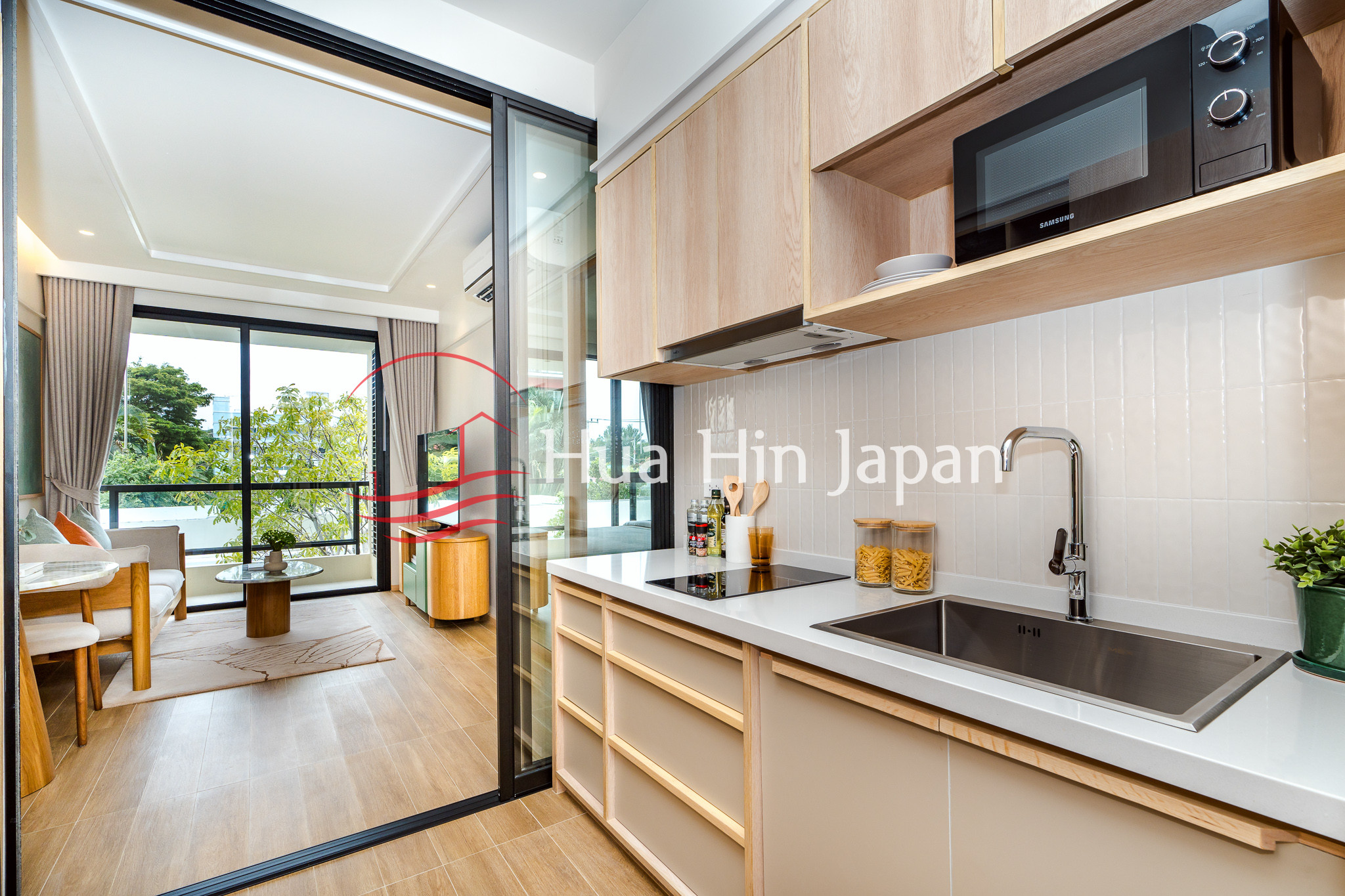
Modern specification. New-build condos in Hua Hin are increasingly built to international standards, with resort-style amenities including pools, co-working spaces, and smart-home systems that older resale stock cannot match. For rental investors, a brand-new unit with a well-managed building typically commands a premium over older inventory.
Off-Plan vs Ready-Built: At a Glance
| Factor | Off-Plan | Ready-Built |
| Entry price | 10–25% below completion value | Market price at time of purchase |
| Payment structure | Staged over 20–30 months | Lump sum (or mortgage) at transfer |
| Unit choice | Full selection at launch | Whatever remains on the market |
| Customisation | Sometimes possible at early stage | None; unit is fixed |
| Rental income | Delayed until handover | Immediate |
| Risk level | Higher (delivery, quality, quota) | Lower (what you see is what you get) |
| Specification | Brand new, modern amenities | Depends on age of building |
What are the risks of buying off-plan, and which ones are unique to Hua Hin?
Off-plan risk in Thailand is real and not limited to fringe developers. Understanding each risk type and how it plays out specifically in Hua Hin is the difference between a controlled purchase and a costly mistake.
Developer failure. This is the worst-case scenario and it carries a structural problem most buyers don’t know about until after they’ve signed: Thai law does not require developers to hold buyer payments in third-party escrow. When you make a milestone payment, the money goes directly into the developer’s bank account. If the developer becomes insolvent before completion, recovering those funds is difficult and time-consuming. You become an unsecured creditor in bankruptcy proceedings. Reputable developers will voluntarily route payments through a law firm or bank escrow arrangement; the absence of escrow is one of the clearest red flags in any off-plan deal.
Construction delays. Delays are the most common off-plan risk in Thailand. Industry data from 2025 shows that 60–70% of Thai off-plan projects experience delays, with typical overruns of 3–12 months beyond the contracted completion date. In Hua Hin, weather (particularly the rainy season) and supply chain issues are the most common causes. A delay of 6 months is an inconvenience. A delay of 18 months or more with no penalty clause in your contract is a serious financial exposure.
The finished unit differs from marketing materials. Renders and show units are always the best version. Ceiling heights, finishes, view corridors, noise levels, and common area quality can all differ from what was presented at point of sale. The only real protection is a tightly written specification clause in your purchase agreement and, where possible, visiting the developer’s completed projects before signing.
Permit and approval risk. Off-plan projects that begin sales before securing all required permits, including an Environmental Impact Assessment (EIA) if required for the project type and scale, and a formal construction permit, represent a significant red flag. Without a condominium licence registered at the Land Department, foreign freehold ownership cannot be registered at all, regardless of what the contract says. This is not a theoretical risk: projects have stalled in Thailand because permit issues were unresolved and buyers had no recourse.
In Hua Hin specifically, one mitigating factor is that the market’s conservative, low-density character means fewer projects of the speculative 400-unit variety that carry the highest failure risk. The typical Hua Hin condo development is smaller, more demand-led, and built by developers with established local track records. That does not eliminate risk. It calibrates it.
How does the 49% foreign quota work, and what can go wrong off-plan?
The foreign quota is not a one-time check. It is a dynamic, building-specific calculation that can change between the day you sign your purchase agreement and the day you try to register ownership at the Land Department, sometimes years later.
Under the Condominium Act B.E. 2522 (1979), foreigners collectively cannot own more than 49% of a building’s total sellable floor area on a freehold basis. The calculation is based on square metres of floor area, not number of units, and it is verified at the moment of ownership registration, not at the moment of purchase.
This creates a specific off-plan risk: a developer may sell more foreign quota units than are actually available, or the quota may be consumed by other buyers between your verification and your title transfer. In fast-moving projects where the foreign quota fills before construction is complete, late-stage buyers can find themselves offered a leasehold arrangement instead of the freehold ownership they believed they were purchasing. Leasehold and freehold are not equivalent: a lease has an expiry date, typically 30 years, and does not appear on the title deed in your name.
The practical steps to protect yourself are: get written confirmation of quota availability for your specific unit at signing; have an independent lawyer verify the quota status directly with the Land Department (not just through the developer’s word); and confirm that your purchase contract specifies freehold ownership with a refund provision if freehold cannot be registered. Freehold ownership requires a properly licensed condominium with a Chanote title. Buildings registered under Nor Sor 3 or Nor Sor 3 Gor cannot be registered as condominiums and foreign freehold is not available in them.
Thai property ownership options article → buying property in Hua Hin as a foreigner
What should I check before signing an off-plan contract in Hua Hin?
Most off-plan problems are not caused by off-plan itself. They are caused by inadequate due diligence before signing. Here is what must be verified, in writing, before any money changes hands.
1. Developer track record. The single strongest predictor of delivery is whether the developer has successfully delivered comparable projects before. Check whether the developer has been involved in court cases or declared bankruptcy, and examine completed projects rather than just marketed ones. If possible, visit a completed building by the same developer and speak with unit owners about their experience.
2. EIA and construction permits. Verify that the project holds an approved Environmental Impact Assessment (if required for the project’s scale and type) and that a valid construction permit has been issued and reflects the actual approved plans. Have your lawyer confirm these directly at the Land Department, not through documents provided by the developer alone.
3. Payment milestones tied to construction progress, not calendar dates. A contract that links your payments to confirmed construction milestones protects you far better than one that schedules payments on calendar months. If the developer stalls construction, milestone-linked contracts mean you stop paying.
4. Delay penalty clause. Your contract should specify a contractual completion date with defined financial penalties for delay, typically 0.05–0.1% of the total purchase price per day, capped at a defined maximum. A contract that says “estimated Q4 2027” with no penalty clause gives you zero financial leverage if construction is abandoned.
5. Completion and refund provision. The contract should allow for a full refund if the developer fails to complete due to insolvency or abandonment. It should also confirm that the developer is the rightful land title owner. If not, the buyer should be entitled to a refund.
6. Independent legal review. Do not rely on the developer’s in-house legal team. An independent Thai property lawyer costs a fraction of the purchase price and is the only professional whose interests are fully aligned with yours.
What do payment schedules look like, and how much cash do you need upfront?
Understanding the payment structure before you sign is not optional. It determines your cash flow exposure for the entire construction period.
The standard Thai off-plan payment schedule runs as follows: a reservation fee of approximately ฿100,000 to secure the unit, a deposit of 10–20% of the purchase price at contract signing, staged milestone payments during construction (typically every 3–6 months), and a final payment of 40–50% at title transfer.
To make this concrete: on a ฿10 million condo, you can expect to pay ฿1–2 million upfront, followed by payments of ฿200,000–500,000 every 3–6 months across a 24–36 month construction window, with a final payment of ฿4–5 million due at handover. Foreign buyers should plan to time these transfers in foreign currency and retain proof of each remittance, because every transferred amount needs to be documented through the FET process for freehold registration.
One important structural point: in Thailand, off-plan milestone payments are almost always made directly into the developer’s bank account, not into a protected escrow arrangement. This is not a technicality. It means your payments have no third-party protection if the developer defaults between milestones. Confirm before signing whether the developer offers any voluntary escrow or bank-backed payment protection; a developer who resists this question is worth scrutinising closely.
FAQ
Is it safe to buy off-plan in Hua Hin as a foreigner?
Buying off-plan in Hua Hin can be safe when done with verified due diligence: confirmed permits, a developer with a completed project track record, and independent legal review before signing. The risk is not in off-plan itself; it is in skipping the steps that exist to protect you.
Do I need a lawyer to buy an off-plan condo in Thailand?
Yes, and not the developer’s lawyer. You need your own, independent Thai property lawyer. They verify permits at the Land Department, review the purchase agreement for penalty and refund clauses, confirm foreign quota status, and ensure the FET documentation is in order for title registration.
Can I rent out my off-plan condo while waiting for completion?
No. You cannot rent out a unit that has not been handed over and does not yet exist as a registered property. Rental income begins at handover. Factor this into your investment timeline: a 24-month construction period means 24 months of zero rental return on capital already being deployed.
What happens to my money if the developer goes bankrupt?
Without escrow, staged payments made directly to the developer are at risk. You become an unsecured creditor in insolvency proceedings, which is a slow and uncertain process. The practical protection is choosing a developer with a strong track record and verified financial position, insisting on milestone-linked payment terms, and ensuring your contract has a clear refund provision for non-completion.

 English
  Japanese
Join The Discussion