
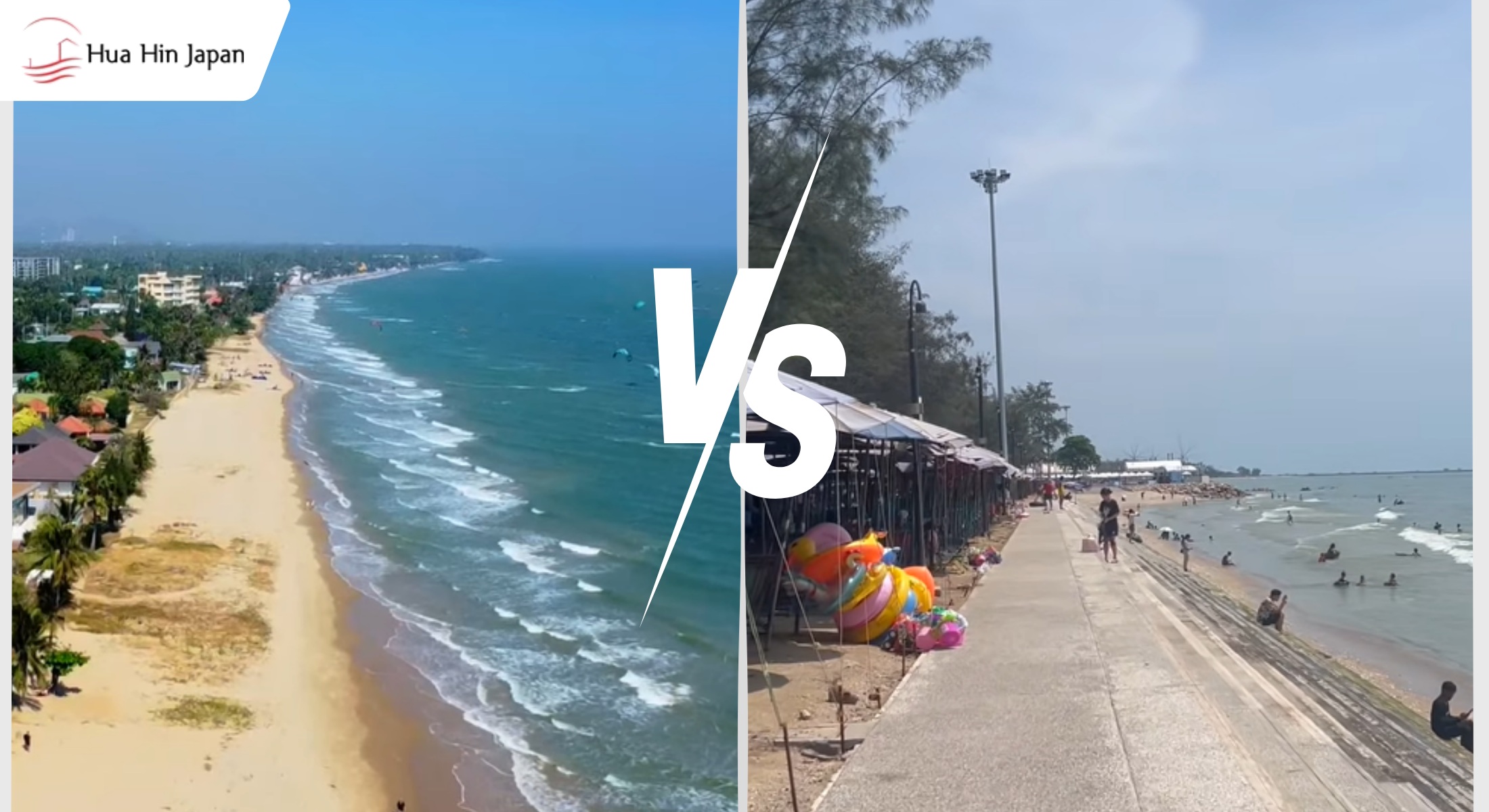
Most guides to Hua Hin hand you a list of eight neighbourhoods and leave you to work out where they sit in relation to each other. That is not what people ask. They ask whether to look north of town or south of it, because those two directions lead to genuinely different daily lives, different property stock, and different price levels.
Below is the comparison itself, anchored to the fixed landmarks that will still be in the same place in twenty years.
Table of Contents
Where does Hua Hin North end and Hua Hin South begin?
Residents draw the line at the town centre, roughly around the clock tower and the railway station. Everything running up toward Bo Fai and Cha-Am counts as north, and everything running down through Nong Kae, Khao Takiab and Khao Tao counts as south.
The corridor is longer than newcomers expect. Phetkasem Road, Highway 4, runs the entire length of it parallel to the coast, and the developed strip stretches well beyond the municipal boundary in both directions.
At the far southern end sits Khao Sam Roi Yot National Park, gazetted in June 1966 as Thailand’s first marine national park and covering just over 98 square kilometres. Its presence matters to buyers for a practical reason: protected land cannot be developed, so the southern corridor has a hard stop built into it. Development below Pranburi thins out rather than sprawls.
The northern end has no equivalent brake. Instead it runs into Cha-Am and keeps going, which is why the north side has more raw land, more room to build, and a looser sense of where Hua Hin actually finishes.
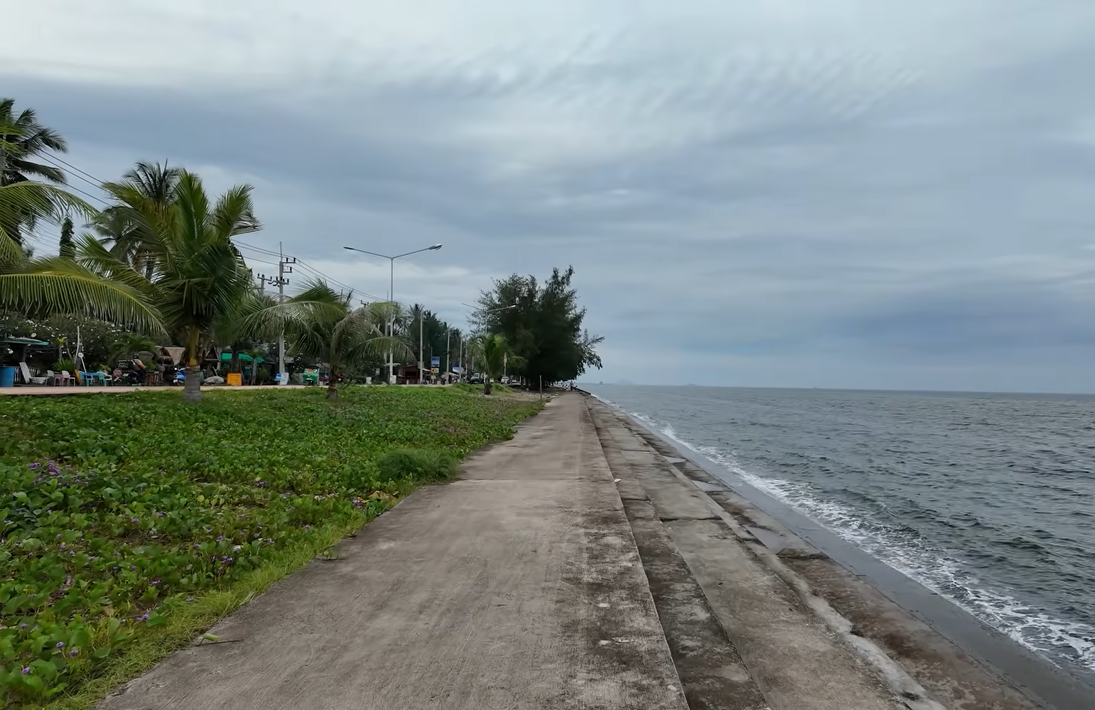
How do Hua Hin soi numbers tell you whether a listing is north or south?
Soi numbers rise as you travel south. Low numbers sit at the northern end of town and the count climbs steadily southward along Phetkasem Road, so the number in any address is a rough position marker before you open a map.
A worked example makes it concrete. Bangkok Hospital Hua Hin sits at 888 Phetchakasem Road. Anything with a soi number well below that address is north of the hospital, and anything above it is further south. Our Soi 88 area guide walks through how one long soi changes character completely from its town end to its villa end, which is a useful illustration of why the number alone never tells the whole story.
Two cautions. The odd and even sides of Phetkasem do not line up with each other, so Soi 61 and Soi 62 are not opposite one another. And a long soi can begin in dense town and finish in open farmland, meaning two listings on the same numbered road can offer entirely different lifestyles.
What are the pros and cons of living in Hua Hin North?
North Hua Hin trades convenience for space. Land prices sit lower, plots run larger, and the pace is calmer, but you accept a longer drive to the malls, the hospital and most of the restaurant scene.
The northern strip covers Bo Fai, the Soi 1 to Soi 51 range including the Naebkehardt corridor, and the stretch continuing toward Cha-Am. Beachfront development along the northern coast has accelerated in recent years, and because the land was cheaper to begin with, the newer projects there often deliver more square metres for the money than an equivalent budget buys near BluPort.
Inland and slightly west, the hills change the equation again. Our guide to Hin Lek Fai and its quiet hills covers the elevated pocket that gives buyers larger plots, cooler evening air, and views over the coastal plain, at the cost of needing a car for absolutely everything.
The honest downsides. Public transport thins out quickly once you leave the central songthaew route. Restaurant choice narrows. And the further north you go, the more the daily errand run turns into a fifteen or twenty minute drive each way, which some buyers find liberating and others find grinding after the first year.
Who it genuinely suits: buyers prioritising land, quiet and value over walkability, and anyone comfortable building their life around a car. If space is the whole point of the move, our breakdown of townhouse versus villa options and prices is worth reading alongside this.
What are the pros and cons of living in Hua Hin South?
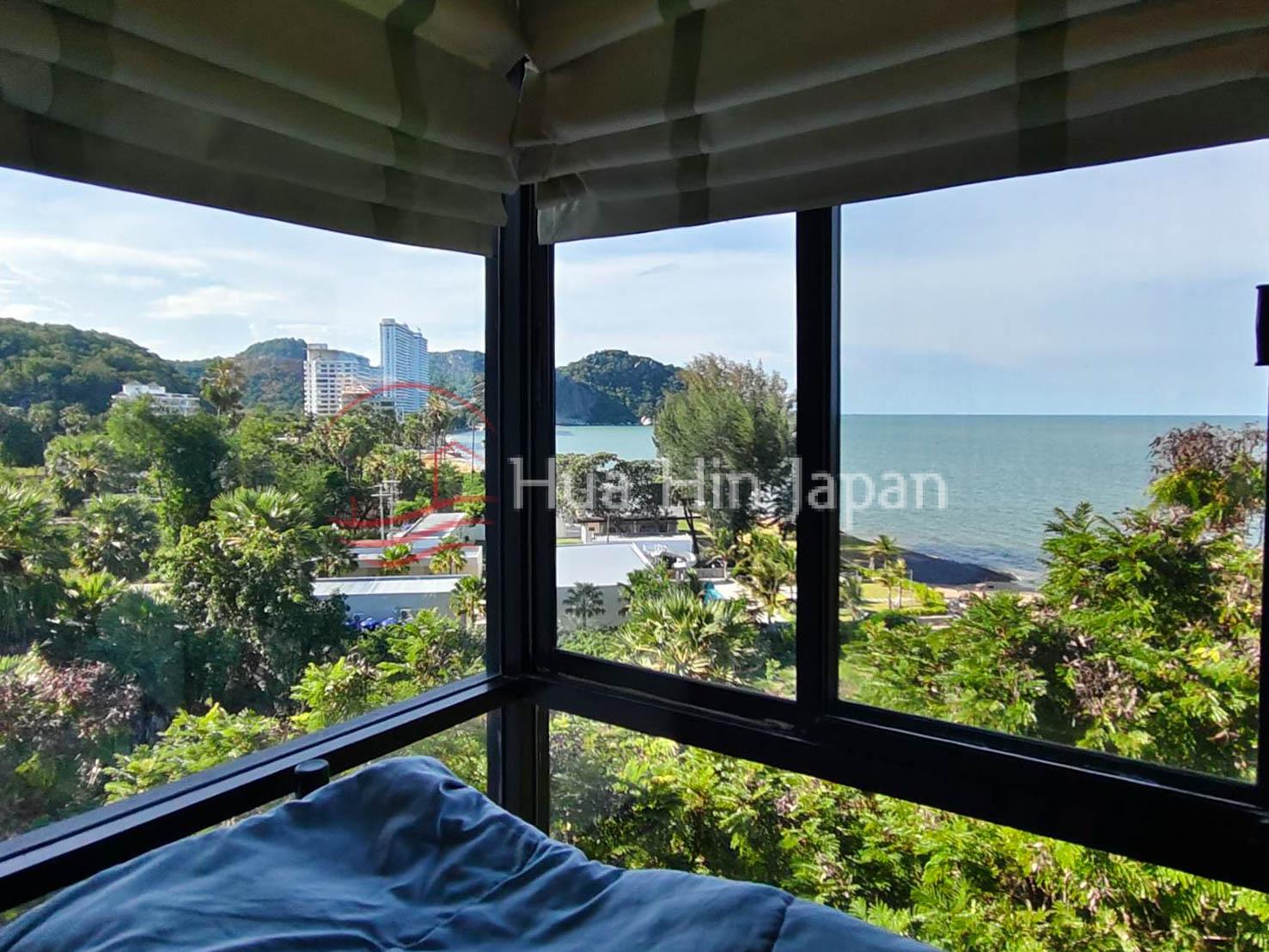
South Hua Hin trades money for convenience and water quality. You pay more per square metre, but you get the better swimming beaches, the densest cluster of amenities, and the shortest drive to almost everything that matters.
The southern strip runs through Nong Kae, Khao Takiab, Suan Son and on to Khao Tao. Beach quality is the headline difference. The central town beach is broad and pleasant for walking, but the water shallows out and the sand carries horse traffic. Head south and the water deepens and clears, which is why residents who actually swim tend to end up on that side.
Amenity density is the second advantage. The southern corridor holds the main mall cluster, the biggest concentration of expat-facing restaurants and gyms, and the weekend markets. Walkability is genuinely possible in pockets here in a way it is not further north, which matters for anyone hoping to avoid car ownership. Our guide to restaurants near the beach covers much of that stretch.
The honest downsides. Prices climb the closer you get to both the beach and the malls, and the compounding effect makes southern beachfront the most expensive stock in the region. Weekend and public holiday traffic is noticeably heavier, because Bangkok arrives on Friday evening and heads for the same coastline. And condo stock dominates in the beachfront pockets, so buyers wanting land often have to move inland toward Thap Tai anyway. If you are weighing that specific decision, our comparison of luxury villas against condos sets out the investment side.
Who it genuinely suits: buyers who want the sea to be a daily habit rather than a weekend outing, anyone who would rather not depend on a car, and investors targeting rental demand.
Hua Hin North vs South at a glance
| Hua Hin North | Hua Hin South | |
| Typical stock | Villas, land plots, newer beachfront projects | Condos near the coast, villas inland |
| Entry price level | Lower per square metre | Higher, rising toward beach and malls |
| Beach quality | Broad, quieter, less developed frontage | Deeper, clearer water for swimming |
| Amenity density | Sparse outside the central strip | Highest concentration in the region |
| Car dependency | Effectively essential | Optional in walkable pockets |
| Weekend traffic | Lighter | Heavier from Friday onward |
| Hard development limit | None, merges into Cha-Am | National park caps the far south |
| Best suited to | Space-first buyers, value seekers | Beach-first buyers, car-free living |
Which side is better for families with school-age children?
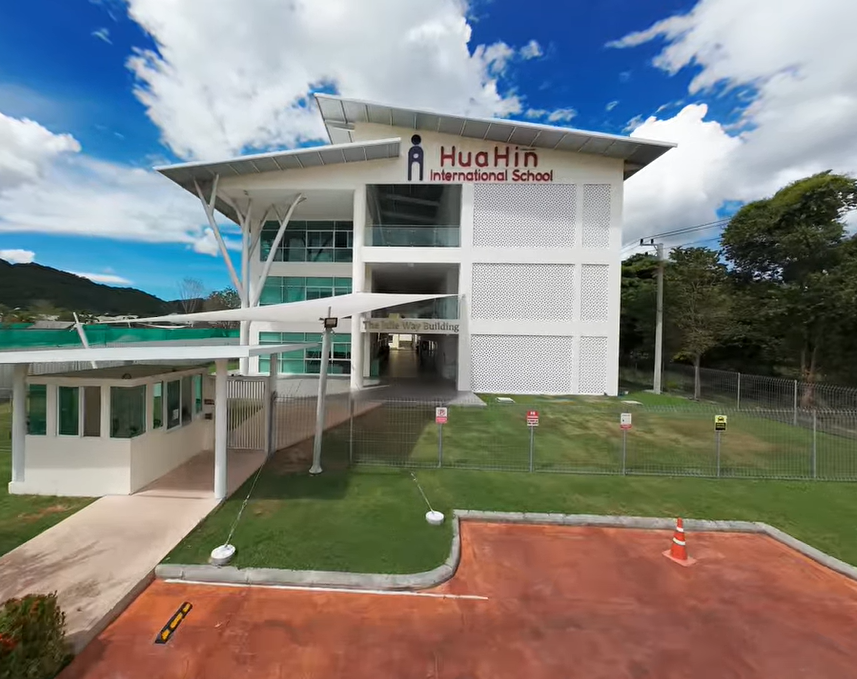
Neither coast wins. The school run pulls families inland and west rather than north or south, because the main international campus sits in the hills rather than on the shoreline.
Hua Hin International School is located in Hin Lek Fai, adjacent to a golf course and a water park, on a hillside campus that opened in 2015 and now teaches more than 430 students from over 30 nationalities. Families who buy purely for beach access and only later enrol children frequently find themselves driving across town twice a day.
The practical consequence is that family buyers should treat the school as a fixed point and work outward from it, rather than choosing a coast first. Areas within a short run of the hills, including the stretch around Black Mountain Golf Club, tend to solve the problem better than either the northern or southern beachfront. Golfing parents comparing the two main courses can read our Black Mountain and Pineapple Valley comparison.
Which side is better for healthcare access in retirement?
South, marginally. The main private hospital sits on Phetkasem south of the town centre, which quietly shortens the journey for southern residents and lengthens it for anyone based well to the north.
Bangkok Hospital Hua Hin operates from 888 Phetchakasem Road, and its position on the main artery means access is straightforward from anywhere along the corridor. The difference is not dramatic in normal circumstances. It becomes significant when you are making the trip weekly for ongoing treatment rather than annually for a check-up, which is exactly the pattern most people move into as they age.
Retirees should also weigh clinic access rather than emergency access alone, since day-to-day medical management matters more over a twenty-year horizon than distance to an emergency room. Our full guide to healthcare in Hua Hin, including hospitals, clinics and insurance options covers what to check before committing to an area.
Does buying north of Hua Hin change the legal process?
It can. Travel far enough north and you cross out of Hua Hin district, Prachuap Khiri Khan, into Cha-Am district, Phetchaburi, which moves your transaction to a different provincial Land Office.
Thailand’s Department of Lands, under the Ministry of Interior, issues land right documents and registers transactions of rights on land and immovable property through the office holding jurisdiction over the parcel. In practice that means the registering office, the queue, the appraised values used to calculate fees, and the officials handling your file all change once you cross the provincial line.
None of that makes a northern purchase harder. It simply means that a buyer comparing a plot near Cha-Am with a plot near Khao Takiab is not comparing like with like on process, and should confirm which office governs the specific parcel before budgeting timelines. Before you get that far, our guide to checking a Chanote title deed covers the verification step that comes first, and our explainer on whether foreigners can own a house in Thailand sets out the ownership structures available either side of the boundary.
Is property cheaper in Hua Hin North or Hua Hin South?
North, as a general rule. Land is cheaper the further you move from the mall and beach cluster, and the northern corridor has more of it, so the same budget consistently buys more space up there than it does around Nong Kae or Khao Takiab.
The rule is not uniform, and the exceptions matter more than the average. Northern beachfront can price close to southern beachfront, because sea frontage carries its own premium regardless of direction. Meanwhile inland pockets in the south, particularly out toward Thap Tai, undercut plenty of northern stock because they are far enough from the water to escape the coastal premium.
The practical test is distance from the sea and distance from the mall cluster, not compass direction. Two properties equidistant from both will usually price within range of each other whichever side of town they sit on. For current figures, our Hua Hin property market report tracks where values are moving, and our breakdown of what 5M, 10M and 20M baht actually buys translates budgets into real stock. Buyers hunting the bottom of the market should also read our guide to the cheapest areas to buy property in Hua Hin.
Do Japanese buyers favour one side of Hua Hin?
Japanese buyers weight convenience and community proximity more heavily than beachfront, which tends to pull them toward the central and southern corridor rather than the far north. Access to familiar amenities and to other Japanese residents usually outranks having sand at the door.
Hua Hin Japan has operated as a bilingual English and Japanese agency in the town since 2005, and agency founder Akemi Morihiro has spent that period placing Japanese-speaking buyers into the market alongside European and Thai clients. Working across two buyer cultures at once surfaces a pattern that single-language agencies rarely see: the criteria that dominate a Japanese buyer’s shortlist are frequently not the criteria that dominate a Scandinavian or British one, even when the budget is identical.
If community is part of your calculation, our overview of the Japanese community in Hua Hin covers where people actually cluster and what services exist in Japanese.
Which side should you choose?
Work backwards from the two or three journeys you will make most often, then pick the side that shortens them.
If you swim daily, choose south. If you want land and privacy above all, choose north. If children are in school here, ignore the coast question and buy within reach of the hills. If ongoing medical care is on the horizon, the southern corridor shortens that trip. If you intend to live without a car, the walkable pockets are almost all in the south.
One more variable that is easy to underestimate: how often you will drive to Bangkok. Buyers who make that trip monthly value bypass access more than beach access, which quietly favours the western and northern approaches over the southern coastline.
Two decades of watching buyers settle on one side or the other has taught our founder Akemi Morihiro a consistent lesson: the people who regret their choice almost never regret the property itself. They regret a journey they underestimated, usually the school run, the hospital trip, or the drive to the supermarket on a wet Tuesday. Walk those routes at the hour you would really make them before you commit to a side.
Anyone still genuinely undecided should rent before buying. Our comparison of long-term rental against buying in Hua Hin sets out the case, and living through one wet season and one high season on your preferred side answers the question more reliably than any guide can. For the wider picture, our honest account of what life is really like in Hua Hin for expats and our 2026 cost of living guide fill in what the neighbourhood comparison leaves out.
Frequently asked questions
Do you need a car in Hua Hin?
In the walkable southern pockets you can manage without one, using songthaews along Phetkasem plus ride-hailing apps. Anywhere north of the central strip or up in the hills, a car moves from convenient to effectively essential.
Is Khao Tao too far from central Hua Hin?
No, it typically runs around fifteen minutes by car outside peak hours. You trade a short drive for quieter evenings and the best swimming water in the region, which most residents who choose it consider a fair exchange.
Are the northern beaches worse than the southern ones?
Not worse, different. Northern frontage is broader and less developed, while southern water is deeper and clearer for actual swimming, so the answer depends entirely on whether you want a beach to walk along or a beach to swim from.
Is flooding a risk on either side?
Risk is determined by the individual plot rather than the compass direction, since land level and estate drainage vary street by street. Elevated areas inland drain naturally, but you should always check the specific parcel’s history rather than trusting an area’s general reputation.
Which side is better for remote work?
The southern corridor has the denser cluster of cafés and coworking-friendly spaces, though connectivity itself is solid across the developed strip. Our guide to internet and working remotely from Hua Hin covers what to check before signing a lease.
Which side holds value better for resale?
Proximity to the sea and to the amenity cluster drives resale more than direction does, which historically favours the southern corridor. Northern stock can perform strongly when infrastructure catches up, but it relies more on future development than on existing demand.
Conclusion
The north versus south question is really a question about what you want your daily routine to look like. North buys you space, quiet and better value per square metre, with a car and a longer errand run as the cost. South buys you swimmable water, walkability and the shortest path to hospitals, malls and restaurants, with a higher price per square metre and busier weekends as the cost.
The fixed points decide it more than the marketing does. The hospital is where it is, the international school is where it is, the national park caps the southern end, and the provincial boundary sits to the north. Map your own week against those four facts and the right side usually picks itself.
If you would like a second opinion on a specific listing or a shortlist across both sides, our team knows the stock on each end of the corridor and can tell you which trade-offs you would actually be signing up for.

 English
  Japanese
Join The Discussion